Showing posts with label Health. Show all posts

Thursday, January 14, 2016

New Year, New You: Revamping Your 2016 Diet Without Breaking the Bank


It's the most wonderful time of the year! The holidays have passed, and the big, home-cooked feasts and hearty leftovers are finally gone. For those who want to revamp their health and wellness, the start of 2016 presents a blank canvas to paint a new picture and a healthier lifestyle.

Here are four easy tips to revamp your diet without breaking the bank.

1. Eat regular meals.
Missing a meal almost always leads to overeating at the next meal. As a result, it is super important to eat regular meals to maintain energy throughout the day and choose more balanced and nutritious foods. Meal prepping is a great way to make sure that you always have something to eat. Plan out your meals each day or week, and make sure to pack enough healthy options to keep you satiated throughout the day.

2. Drink water 30 minutes before eating.
Image result for drinking a glass of water
"Always start meals with a glass of water"- Shane Allen

Drinking water before eating can fill your stomach and increase satiety (Stookey, JD). Once satiated, you're more likely to make better decisions about what you eat. 

One study recruited a group of 84 overweight adults for a 12-week experiment. Everyone was given general wight loss advice, then assigned to one of two groups. One group was told to drink 16 ounces of water 30 minutes before their meals while the other group was told to simply imagine their stomachs were full before meals. Findings showed that the group that drank at least 16 ounces of water lost an average of three more pounds than the group that didn't increase their water intake. Results also showed that the more water that participants drank before meals, the better their weight loss. 

3. Don't grocery shop while hungry.

If you've ever gone grocery shopping while hungry, you know the tangled web you wove. On an empty stomach, everything in the grocery store looks gooooooood, especially those Oreos and Zebra Cakes. As a result, it is best to avoid shopping while hungry. One study found that when compared to participants who had eaten before shopping, those who had not eaten were much more likely to purchase more high-calorie products. 

4. Avoid diet sabotagers.

Diet sabotagers come in two forms: food and folks. 

Certain foods are notorious for being high in fat, carbs, and sugars. These are the foods that you want to avoid if you are looking to adopt a healthier lifestyle or lose weight. Starchy carbs and sugary extras are diet sabotagers! Both pack on pounds much quicker and with negative side effects such as increased blood glucose levels. 

People can also sabotage your diet (we all have that one friend who always wants to meet at the food trucks for lunch)! The key to success in these situations is having the willpower to say, "No," or finding a healthier alternative. For example, instead of meeting at the food trucks for lunch, suggest a walking lunch where the meeting not the food is the focus.


SOURCES

1. Stookey, JD, F. Constant, and BM Popkin. "Drinking Water Is Associated With Weight Loss in Overweight Dieting Women Independent of Diet and Activity." Drinking Water Is Associated with Weight Loss in Overweight Dieting Women Independent of Diet and Activity 16.11 (2008): 2481-488. Pub Med. Web. 14 Jan. 2016.

Tuesday, September 29, 2015

Depicting Obesity in Black America

DEPICTING OBESITY IN BLACK AMERICA

Overview

Obesity is a major health problem for millions of Americans. Dietary patterns, physical inactivity, medication use, and other exposures contribute to the prevalence of obesity in America. In an article, "Is Fat the New Normal?" Sherry Rauh likens obesity among Americans to tallness among basketball players.

African American adults are 1.5 times as likely to be obese compared 
with white adults, and over 75% of African Americans are overweight
compared with 67.2% of White Americans. 
(State of Obesity - RWJ Foundation)
"If you're tall enough to stand out in a crowd, you're probably aware of your tallness - maybe even self-conscious about it. But imagine that you're in a room full of basketball players. Suddenly, you don't seem so tall anymore. Your above average height feels normal." - S. Rauh

Rauh suggests that if we equate "normal" with average, it's not a stretch to say that in America, it's normal to be obese. The average or "normal" American adult's BMI is 28.6, which signifies overweight.  The new normality of excess weight makes it very difficult for Americans to recognize what obesity looks like. This poses a serious concern in populations such as African Americans where obesity is highly prevalent. 


Rush University MC Study

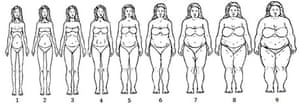
A study conducted by researchers from the Rush University Medical Center in Chicago, recruited sixty-nine African American women from a low income neighborhood of Chicago and asked them to identify which of the nine women (shown below) were overweight, obese, and "too fat". The consensus was that of the nine women shown, only 8 and 9 were "too fat" (Boosely).

African American women body image scale

Implications
This simple study conveys a larger disagreement between cultural and medical definitions of "healthy" in the African American community. This disconnect poses a much larger problem considering the effect of obesity on quality of life and risk for other chronic diseases such as diabetes, heart disease, hypertension, and some types of cancer. Since these illnesses are already disproportionately prevalent in minority populations, measures must be taken to mend this disconnect and push African Americans toward health equity. 

What could be done?
1. Examination of social determinants of health that contribute to African American obesity. Determinants such as income, neighborhood, educational attainment, food advertising, and access to parks, grocery stores, and green space all play a critical role in the overall health of a community. African American communities face significant disparities in these determinants. Therefore, to help African Americans live healthier lives, these disparities must be eradicated. This will require strategic programs, policies, and neighborhood revitalization efforts that increase the availability and access to healthy food and safe space to be physically active in African American communities.

2. Development of culturally relevant healthy living and weight loss programs tailored to meet the unique needs of African AmericansTo enhance cultural relevance and appeal to African Americans, these programs should solicit input from population members, use culturally relevant intervention content, incorporate population media figures, utilize culturally relevant forms of physical activity, and address specific population linked barriers to activity (Conn). For example, Steps to Soulful Living, a weight loss intervention for African American women, successfully reduced participants' weight by 8 - 15 pounds using these strategies (Karanja).

3. Use of nontraditional partners to increase health education in minority and low income communities. Instead of relying on traditional health education providers such as hospitals and clinics, providers should use nontraditional sources such as churches, community centers, sorority and fraternities, and barbershops/salons to conduct successful lifestyle interventions in settings that are both familiar and comfortable in the Black community (Kennedy et al).

Sources:
Boseley, Sarah. "Do You Know What Fat Looks Like?" Editorial. Obesity: The Shape We're In Blog. The Guardian, 10 Sept. 2014. Web. 29 Sept. 2015.

Conn, Vicki S., Keith Chan, JoAnne Banks, Todd M. Ruppar, and Jane Scharff. "Cultural Relevance of Physical Activity Intervention Research with Underrepresented Populations." Int Q Community Health Education34.4 (2013): 391-414. NCBI. U.S. National Library of Medicine. Web. 30 Sept. 2015.

Karanja, N., VJ Stevens, JF Hollis, and SK Kumanyika. "Steps to Soulful Living (steps): A Weight Loss Program for African-American Women." Ethnicity and Disease 12.3 (2002): 363-71. National Center for Biotechnology Information. U.S. National Library of Medicine. Web. 30 Sept. 2015.

Kennedy, Betty, Jamy Ard, Louis Harrison, Beverly Conish, Eugene Kennedy, Erma Levy, and Phillip Brantley. "Cultural Characteristics of African Americans: Implications for the Design of Trials That Target Behavior and Health Promotion Programs." Ethnicity and Disease 17 (2007): 548-54. Cite Seer X. Pennsylvania State University. Web. 30 Sept. 2015.

Rauh, Sherry. "Is Fat Normal in America? A Surprising Reason Why We're Gaining Weight." WebMD. WebMD, n.d. Web. 29 Sept. 2015.


The State of Obesity: Racial and Ethnic Disparities in Obesity. Rep. N.p.: Robert Wood Johnson Foundation, 2014. Web. 30 Sept. 2015.

Wednesday, September 23, 2015

Shifting the Health Equity Focus from Accessibility to Outcomes

Access to Care < Health Outcomes?


Background

Source: http://www.nyas.org/
It is well documented that racial and ethnic minorities face worse health and health care disparities than any other group. Several socioeconomic factors such as neighborhood, educational attainment, and income level lead to a lesser standard of health care and worse health outcomes in minority communities. To address these disparities, several health care organizations have begun to develop interventions focused on narrowing the gap between social determinants of health and health equity. For years, the focus these interventions has been access to care, which hemmed on the belief that issues such as lack of insurance, cost of services, and availability of providers were the major sources of disparity. However, difficulties in reducing these disparities have prompted public health and healthcare practitioners to look elsewhere.


A Shift in Focus


"Health organizations can promote and sustain equity by broadening the scope of health care systems and promoting interventions that focus on the core contributors to disease."

In the article Achieving Health Equity by Design, authors from the American Medical Association suggest health practitioners shift their health disparities work from efforts to increase cultural competence, patient safety, and health literacy to those that target equity in health outcomes. The authors suggest that instead of focusing on efforts to "retrofit the current healthcare system to make it more accessible to patients," health care organizations should focus more on the factors that cause disproportionate lack of access and sustained treatment in minority communities. This shift requires health care organizations to adopt unconventional methods to provide education and services in places where racial and ethnic minorities live and work. Some health care organizations have already begun to move toward this framework.

Source: media.npr.org
For example, in 2010, the CDC piloted barbershop hypertension management programs in Los Angeles and St. Louis to implement system-level hypertension control interventions for African American men. These programs trained barbers and stylists in the African American community to become community blood pressure specialists who measure and record blood pressure readings of customers, provide information about hypertension,a nd make referrals to providers. Barbershops were specifically targeted because, in the African American community, barbershops are quintessential, gender-specific places for gathering and fellowship. An evaluation of the barbershop intervention found that African American men who received service through the intervention had a decrease in blood presure and an increase in hypertension treatment and control. These results show promise for future collaborations between heatlh care organizations and nontraditional partners such as faith-based organizations, fraternities and sororities, and barbershops. Through these partnerships, health care organizations can circumvent social determinants of health and move minority communities toward health equity. 

Sources:

Centers for Disease Control and Prevention. A Closer Look at African American Men and High Blood Pressure Control: A Review of Psychosocial Factors and Systems-Level Interventions. Atlanta: U.S. Department of Health and Human Services; 2010.

Wein, Harry. "Barbers Help Black Men Beat High Blood Pressure - NIH Research Matters National Institutes of Health (NIH)." NIH Research Matters. National Institutes of Health, n.d. Web. 23 Sept. 2015.


Wong, Winston F., Thomas A. LaVeist, and Joshua Sharfstein. "Achieving Health Equity by  Design." The Journal of the American Medical Association 313.14 (2015): 1417-1418. JAMA Network. American Medical Association. Web. 23 Sept. 2015.

Thursday, August 27, 2015

The Effect of Neighborhood Residence on Health Outcomes

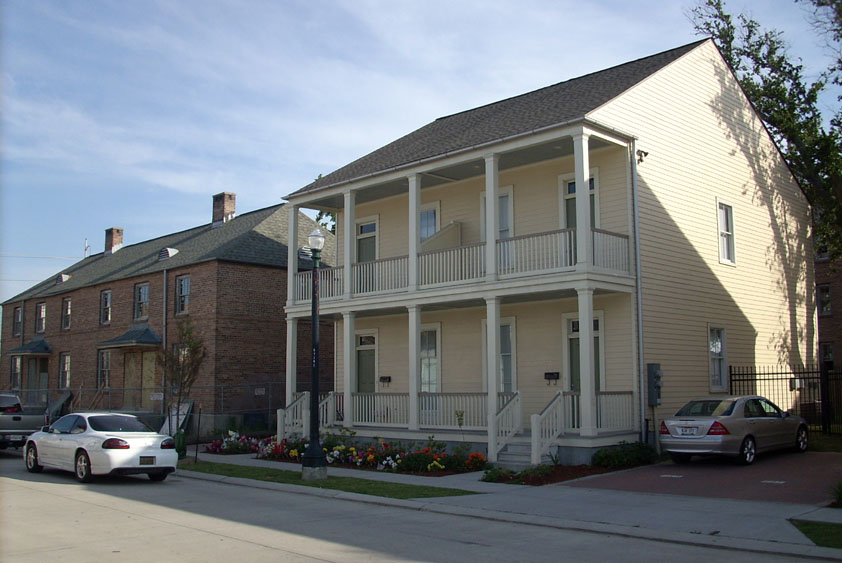
St. Thomas Housing Projects - New Orleans, LA circa 2004
Source: Reuters.com
St. Thomas Housing Projects - New Orleans, LA circa 2009
Source: Jeffrey Murrell, seabrite.com

"The health consequences of neighborhood poverty are a public health problem." -- Dr. Tama Levanthal

Data shows that neighborhood residence affects physical and mental health outcomes. Individuals who grow up in or move to to high-opportunity, low-poverty neighborhoods are less likely to face physical and mental health issues whereas those living in low-opportunity, high-poverty neighborhoods have higher incidences of poor physical and mental health outcomes (Levanthal,1). This theory was tested in Moving to Opportunity (MTO), an experiment designed and implemented by the U.S. Department of Housing and Urban Development. In the experiment, volunteer families living in public and assisted housing projects n Baltimore, Boston, Chicago, Los Angeles, and New York were randomly assigned to one of three one of three treatment groups: the experimental group, the comparison group, and the control group. The experimental group received housing vouchers for one year that could only be used in low-poverty neighborhoods; the comparison group received regular housing vouchers that could be used in any neighborhood; and the control group remained in the housing projects. Results from the study showed that MTO experimental families enjoyed significantly better health outcomes than the control group.

The results from this study are consistent with previous research that indicates that neighborhood environment matters for low-income youth and adults. The MTO study found significant relationships between neighborhood opportunity and individual health outcomes. In general, those living in high-opportunity neighborhoods experienced less obesity, asthma, and fewer physical health problems than those living in low-opportunity neighborhoods.

This clear and convincing evidence that neighborhood affects long-term health outcomes indicates the need for viable strategies to provide low-income youth with access to the resources afforded to youth in high-opportunity neighborhoods. Cities such as Chicago, Baltimore, and Dallas have already begun to work toward this goal through regional mobility programs such as the Housing Choice Voucher program which provides counseling and related support and assistance to help low income families navigate the housing market and find the best home for them. These programs' successes exemplify the potential progress that can be made when law and policy makers, experts, and advocates collaborate to do meaningful work aimed at eradicating the social determinants of health that plague underserved communities.

Sources
Julian, Elizabeth (2015). Mobility Works America. Poverty and Race, 24(04), 1 - 2.
Leventhal, T., & Brooks-Gunn, J. (2003). Moving to Opportunity: an Experimental Study of 
        Neighborhood Effects on Mental Health. American Journal of Public Health93(9), 1576–1582.

Monday, July 13, 2015

Flip This Clinic: An Open Experiment for Patient Centered Care

Flip This Clinic: An Open Experiment for Patient Centered Care


Recently, I read a book called Doctor, the Patient will See you Now. It's a fascinating read by Steven Kussin that provides readers with valuable tools to protect their health as they navigate the health care system. As the author transforms from doctor to patient, the readers are given a behind-the-scenes look into the realities of the health care system, and the ways that patients must advocate for themselves in the health care arena. 

New technologies, tools, and social media platforms give patients the power to be more informed and more engaged in their health care. The idea of patient-centered care is emulated in Flip the Clinic a new, open experiment sponsored by the Robert Wood Johnson Foundation that aims to explore new approaches to patient-provider encounters by re-imagining the ways that health care is delivered. Each flip presents a bold new way of looking at the health care encounter. My three favorite flips are discussed below.
  • Flip #35: Model the clinic like the Apple Store. The Apple Store is well known for its customer-centered design. Within seconds of walking into the store, customers are warmly greeted and assisted. There is little upselling, few transactions that require customers to stand in line, and the employees are reliably friendly and knowledgeable. Essentially, all the customer has to do is show up. Dr. Keith Seidel, medical director at Southeast Health Center in San Francisco, California decided to model his clinic after the Apple Store to create a patient-friendly atmosphere from the moment the door is opened. The ultimate goal is to triage patients more efficiently and get to a point of care much quicker. 
  • Flip #55: Increase Digital Health Record Engagement. Though 92 percent of hospitals have a system in place to provide patients with a way to obtain an electronic copy of their health record, very few patients actually use the service. The hassle of getting health records is a major complaint of many patients. So, to move toward a more patient-centered experience, clinicians, medical offices, and health systems are striving to spread the word about electronic health record access by being open data advocates.
  •  Flip #33. Provide context, improve understanding, and generate empathy between physician and patient. Although whole health and wellness is the goal for physicians and patients, often there is a disconnect between physician and patient perspectives on what that means. This pilot aims to help provide context, improve understanding, generate empathy, and drive change in behaviors between physician and patient to bridge the disconnect. Starting in February 2015, several participants from the San Francisco Flip the Clinic Lab tweeted suggestions on how to improve health care delivery and experience using hashtags #Iwishmydoc and #Iwishmypatient. The exchange provided patients and physicians with an open forum to express ideas and give suggestions. In this way, physicians were able to plug in and see what really mattered to patients most and respond to those inquiries if they had additional questions. 
Sources: 
  1. http://fliptheclinic.org/flips/how-can-we-provide-context-improve-understanding-and-generate-empathy-between-physician-and-patient/
  2. http://fliptheclinic.org/flips/run-a-clinic-like-its-the-apple-store/
  3. http://fliptheclinic.org/flips/accessourdata/
  4. http://fliptheclinic.org/